Solving Poisson PDE Systems (https://
with boundary conditions
where
using NeuralPDE
using Lux
using Optimization
using OptimizationOptimJL
using ModelingToolkit
using DomainSets
using LineSearches
using Plots
2D PDE
@parameters x y
@variables u(..)
Dxx = Differential(x)^2
Dyy = Differential(y)^2
eq  = Dxx(u(x, y)) + Dyy(u(x, y)) ~ -sinpi(x) * sinpi(y)
Differential(y, 2)(u(x, y)) + Differential(x, 2)(u(x, y)) ~ -sinpi(x)*sinpi(y)Boundary conditions
bcs = [
    u(0, y) ~ 0.0,
    u(1, y) ~ 0.0,
    u(x, 0) ~ 0.0,
    u(x, 1) ~ 0.0
]
4-element Vector{Symbolics.Equation}:
u(0, y) ~ 0.0
u(1, y) ~ 0.0
u(x, 0) ~ 0.0
u(x, 1) ~ 0.0Space domains
domains = [
    x ∈ DomainSets.Interval(0.0, 1.0),
    y ∈ DomainSets.Interval(0.0, 1.0)
]
2-element Vector{Symbolics.VarDomainPairing}:
Symbolics.VarDomainPairing(x, 0.0 .. 1.0)
Symbolics.VarDomainPairing(y, 0.0 .. 1.0)Build a neural network for the PDE solver.
Input: 2 dimensions.
Hidden layers: 16 neurons * 2 layers.
Output: single output u(x, y)
dim = 2
chain = Lux.Chain(Dense(dim, 16, Lux.σ), Dense(16, 16, Lux.σ), Dense(16, 1))
Chain(
layer_1 = Dense(2 => 16, σ), # 48 parameters
layer_2 = Dense(16 => 16, σ), # 272 parameters
layer_3 = Dense(16 => 1), # 17 parameters
) # Total: 337 parameters,
# plus 0 states.Discretization method usesPhysicsInformedNN() (PINN).
dx = 0.05
discretization = PhysicsInformedNN(chain, QuadratureTraining(; batch = 200, abstol = 1e-6, reltol = 1e-6))
NeuralPDE.PhysicsInformedNN{Lux.Chain{@NamedTuple{layer_1::Lux.Dense{typeof(NNlib.σ), Int64, Int64, Nothing, Nothing, Static.True}, layer_2::Lux.Dense{typeof(NNlib.σ), Int64, Int64, Nothing, Nothing, Static.True}, layer_3::Lux.Dense{typeof(identity), Int64, Int64, Nothing, Nothing, Static.True}}, Nothing}, NeuralPDE.QuadratureTraining{Float64, Integrals.CubatureJLh}, Nothing, Nothing, NeuralPDE.Phi{LuxCore.StatefulLuxLayerImpl.StatefulLuxLayer{Val{true}, Lux.Chain{@NamedTuple{layer_1::Lux.Dense{typeof(NNlib.σ), Int64, Int64, Nothing, Nothing, Static.True}, layer_2::Lux.Dense{typeof(NNlib.σ), Int64, Int64, Nothing, Nothing, Static.True}, layer_3::Lux.Dense{typeof(identity), Int64, Int64, Nothing, Nothing, Static.True}}, Nothing}, Nothing, @NamedTuple{layer_1::@NamedTuple{}, layer_2::@NamedTuple{}, layer_3::@NamedTuple{}}}}, typeof(NeuralPDE.numeric_derivative), Bool, Nothing, Nothing, Nothing, Base.RefValue{Int64}, Base.Pairs{Symbol, Union{}, Nothing, @NamedTuple{}}}(Lux.Chain{@NamedTuple{layer_1::Lux.Dense{typeof(NNlib.σ), Int64, Int64, Nothing, Nothing, Static.True}, layer_2::Lux.Dense{typeof(NNlib.σ), Int64, Int64, Nothing, Nothing, Static.True}, layer_3::Lux.Dense{typeof(identity), Int64, Int64, Nothing, Nothing, Static.True}}, Nothing}((layer_1 = Dense(2 => 16, σ), layer_2 = Dense(16 => 16, σ), layer_3 = Dense(16 => 1)), nothing), NeuralPDE.QuadratureTraining{Float64, Integrals.CubatureJLh}(Integrals.CubatureJLh(0), 1.0e-6, 1.0e-6, 1000, 200), nothing, nothing, NeuralPDE.Phi{LuxCore.StatefulLuxLayerImpl.StatefulLuxLayer{Val{true}, Lux.Chain{@NamedTuple{layer_1::Lux.Dense{typeof(NNlib.σ), Int64, Int64, Nothing, Nothing, Static.True}, layer_2::Lux.Dense{typeof(NNlib.σ), Int64, Int64, Nothing, Nothing, Static.True}, layer_3::Lux.Dense{typeof(identity), Int64, Int64, Nothing, Nothing, Static.True}}, Nothing}, Nothing, @NamedTuple{layer_1::@NamedTuple{}, layer_2::@NamedTuple{}, layer_3::@NamedTuple{}}}}(LuxCore.StatefulLuxLayerImpl.StatefulLuxLayer{Val{true}, Lux.Chain{@NamedTuple{layer_1::Lux.Dense{typeof(NNlib.σ), Int64, Int64, Nothing, Nothing, Static.True}, layer_2::Lux.Dense{typeof(NNlib.σ), Int64, Int64, Nothing, Nothing, Static.True}, layer_3::Lux.Dense{typeof(identity), Int64, Int64, Nothing, Nothing, Static.True}}, Nothing}, Nothing, @NamedTuple{layer_1::@NamedTuple{}, layer_2::@NamedTuple{}, layer_3::@NamedTuple{}}}(Lux.Chain{@NamedTuple{layer_1::Lux.Dense{typeof(NNlib.σ), Int64, Int64, Nothing, Nothing, Static.True}, layer_2::Lux.Dense{typeof(NNlib.σ), Int64, Int64, Nothing, Nothing, Static.True}, layer_3::Lux.Dense{typeof(identity), Int64, Int64, Nothing, Nothing, Static.True}}, Nothing}((layer_1 = Dense(2 => 16, σ), layer_2 = Dense(16 => 16, σ), layer_3 = Dense(16 => 1)), nothing), nothing, (layer_1 = NamedTuple(), layer_2 = NamedTuple(), layer_3 = NamedTuple()), nothing, Val{true}())), NeuralPDE.numeric_derivative, false, nothing, nothing, nothing, NeuralPDE.LogOptions(50), Base.RefValue{Int64}(1), true, false, Base.Pairs{Symbol, Union{}, Nothing, @NamedTuple{}}())Build the PDE system and discretize it.
@named pde_system = PDESystem(eq, bcs, domains, [x, y], [u(x, y)])
prob = discretize(pde_system, discretization)OptimizationProblem. In-place: true
u0: ComponentVector{Float64}(layer_1 = (weight = [-1.045601725578308 -0.10921033471822739; 1.091493010520935 -0.18767650425434113; … ; -0.46106433868408203 0.22992028295993805; 0.915541410446167 -0.867740273475647], bias = [-0.3490026295185089, -0.5115582942962646, -0.5690100193023682, -0.08262906223535538, 0.6889359951019287, 0.39675045013427734, -0.3616393506526947, 0.4941050410270691, -0.37188026309013367, 0.45623844861984253, -0.5051567554473877, -0.3407018184661865, 0.7008427381515503, 0.6059771180152893, 0.014963648281991482, 0.5286787748336792]), layer_2 = (weight = [0.06755463033914566 0.16899268329143524 … -0.19711469113826752 0.1807904988527298; 0.4115501940250397 0.06671659648418427 … -0.3102651834487915 -0.019414111971855164; … ; -0.3194742500782013 0.06836268305778503 … -0.030815385282039642 -0.14694052934646606; -0.23023533821105957 0.18522308766841888 … -0.22952422499656677 0.10553862899541855], bias = [0.14362940192222595, -0.08819934725761414, 0.23475956916809082, 0.21281558275222778, -0.12065193057060242, -0.10474029183387756, -0.1616690754890442, 0.24242505431175232, -0.18419599533081055, 0.11514776945114136, -0.03171294927597046, -0.12478068470954895, -0.11491352319717407, 0.13035660982131958, 0.16441944241523743, -0.20528900623321533]), layer_3 = (weight = [-0.3666118085384369 0.03553791716694832 … -0.2301514595746994 0.41848769783973694], bias = [-0.011502742767333984]))Callback function to record the loss
lossrecord = Float64[]
callback = function (p, l)
    push!(lossrecord, l)
    return false
end
#2 (generic function with 1 method)Solve the problem. You can increase maxiters to get a better solution, but it will take more time.
opt = OptimizationOptimJL.LBFGS(linesearch = LineSearches.BackTracking())
@time res = Optimization.solve(prob, opt, callback = callback, maxiters=100)
334.433801 seconds (1.13 G allocations: 63.464 GiB, 2.90% gc time, 32.98% compilation time)
retcode: MaxIters
u: ComponentVector{Float64}(layer_1 = (weight = [-2.246108250055807 1.772792883950308; 1.8766584116918135 -0.3764065507640711; … ; -1.4145450849739856 -0.8058043208178515; 0.7056130522230699 -0.31418418088797506], bias = [-0.1930480784297757, -1.1698734758061016, -0.5855957732744279, -0.21603834038289826, 0.1839592933647991, 0.283659901506895, -0.5964637308265895, -0.23007897330147245, -0.4967890085472386, 0.5560042471052046, -1.1236828087320831, -0.39665306905589515, -1.1619675794912372, 1.2913611902823703, 0.39628818821212486, 0.20944882302922274]), layer_2 = (weight = [0.13204165050378144 0.06719821742142248 … -0.26013320357533265 -0.33310747416396935; 0.2875670909744126 0.051790480960252995 … -0.3865584724926057 -0.2807309907110464; … ; -0.044373324478931796 -0.4287483074767748 … 0.21280720388556357 0.47034472573429525; -0.40825879195649667 0.4616449278518109 … -0.26554492068454794 0.5498057157800589], bias = [0.16271509657823247, -0.04749907181511072, 0.335002466496306, 0.5451480638667354, 0.5961443900218559, -0.1294079443748471, -1.2955919627606456, 0.2737882953195958, -0.11805831949736428, 0.1674395861694066, 0.0932211714189041, 0.012309427678531512, 0.36598353897043046, 0.45134862150971616, -0.36972772952940625, -0.04831152180674929]), layer_3 = (weight = [0.10155469024303497 -0.6488592554865341 … -0.620215020089187 0.806569657755751], bias = [-0.8100184935455451]))
plot(lossrecord, xlabel="Iters", yscale=:log10, ylabel="Loss", lab=false)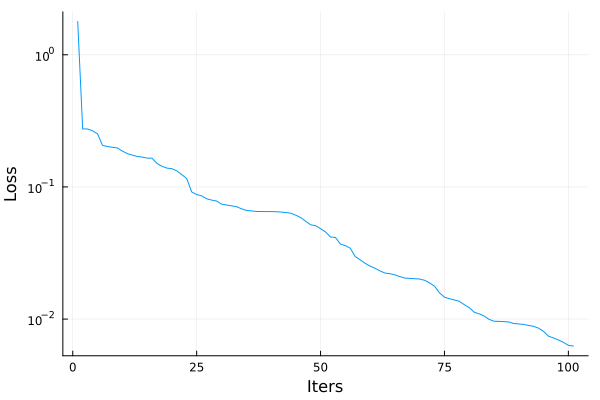
Plot the predicted solution of the PDE and compare it with the analytical solution to see the relative error.
xs, ys = [DomainSets.infimum(d.domain):dx/10:DomainSets.supremum(d.domain) for d in domains]
analytic_sol_func(x,y) = (sinpi(x)*sinpi(y))/(2pi^2)

phi = discretization.phi
u_predict = reshape([first(phi([x, y], res.u)) for x in xs for y in ys], (length(xs), length(ys)))
u_real = reshape([analytic_sol_func(x, y) for x in xs for y in ys], (length(xs), length(ys)))
diff_u = abs.(u_predict .- u_real)
201×201 Matrix{Float64}:
0.00795623 0.00739334 0.00683437 … 0.0202576 0.0206742 0.0210874
0.00772117 0.00717064 0.00662395 0.0196112 0.0200153 0.0204159
0.0074827 0.0069445 0.00641008 0.0189649 0.0193566 0.0197447
0.00724084 0.00671494 0.00619274 0.018319 0.0186982 0.0190739
0.00699558 0.00648195 0.00597196 0.0176736 0.0180404 0.0184036
0.00674697 0.00624557 0.00574775 … 0.0170289 0.0173833 0.0177342
0.00649501 0.00600582 0.00552012 0.0163851 0.0167271 0.0170657
0.00623973 0.0057627 0.00528911 0.0157423 0.0160721 0.0163983
0.00598116 0.00551626 0.00505472 0.0151007 0.0154182 0.0157323
0.00571933 0.00526652 0.004817 0.0144605 0.0147659 0.0150677
⋮ ⋱ ⋮
0.0077677 0.00783895 0.00790675 0.0145388 0.0146517 0.0147629
0.00836831 0.0084323 0.00849285 0.0151165 0.0152385 0.0153589
0.0089727 0.0090294 0.00908264 0.0156962 0.0158274 0.0159569
0.00958078 0.00963014 0.00967604 … 0.0162778 0.0164182 0.0165569
0.0101924 0.0102344 0.010273 0.0168613 0.0170109 0.0171588
0.0108076 0.0108422 0.0108733 0.0174466 0.0176053 0.0177625
0.0114261 0.0114533 0.0114769 0.0180337 0.0182016 0.018368
0.012048 0.0120676 0.0120838 0.0186224 0.0187995 0.0189751
0.012673 0.0126851 0.0126938 … 0.0192127 0.019399 0.0195838p1 = plot(xs, ys, u_real, linetype=:contourf, title = "analytic");
p2 = plot(xs, ys, u_predict, linetype=:contourf, title = "predicted");
p3 = plot(xs, ys, diff_u, linetype=:contourf, title = "error");
plot(p1, p2, p3)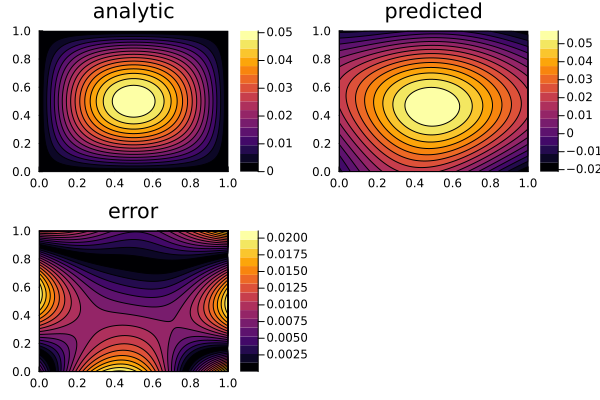
This notebook was generated using Literate.jl.